The Monday Problem: Why Open House Leads Go Cold, and the Follow-Up That Fixes It
The Monday Problem: Why Open House Leads Go Cold, and the Follow-Up That Fixes It
The open house went well. Twenty people came through, a few of them were serious, and you have the sign-in sheet to prove it. By Thursday, most of them won't remember your name. Here's why that happens and the follow-up routine that stops it.
Sunday at four, you lock up feeling good. The kitchen got the reaction you hoped for, a couple asked smart questions about the roof, and a neighbor told you she's been "thinking about it" for a year.
Monday arrives with a closing, two showings and a contract that needs attention. The sign-in sheet goes on the passenger seat. Tuesday it moves to the desk. Wednesday you send a group email that starts "Thanks for stopping by!" By then the couple who asked about the roof has toured three more homes, and one of those listing agents texted them that same night.
That's the Monday problem. Hosting an open house is the visible part of the work, and most agents do it well. The follow-up is the part that turns visitors into clients, and it's usually the part that gets squeezed out.
The fix isn't more effort. It's a short routine that starts before you leave the driveway.
"The open house is where you meet people. The follow-up is where you earn them."

Why Open House Leads Go Cold
When you look closely, open house leads rarely go cold because the visitors weren't interested. They go cold for three reasons that have nothing to do with the visitors.
1. The sign-in sheet is a list, not a memory
By the time you sit down to follow up, the names have lost their faces. Was Jamie the one with the dog, or the one relocating for a job? Without the detail, the follow-up has to be generic, and generic follow-up reads like a mass email because it is one.
2. Everyone gets the same message
A buyer who's pre-approved and touring every weekend, a neighbor who's curious about prices and a couple who already has an agent walked through the same door for very different reasons. One "Thanks for stopping by, let me know if you have questions!" fits none of them.
3. One touch, then nothing
Most open house follow-up is a single message. If the visitor isn't ready that week, the relationship ends there. The people most likely to become clients are often the ones who weren't ready yet.
The Follow-Up That Works
This routine takes about an hour across the first two days, then a few minutes here and there for two weeks. It works whether you track visitors in a spreadsheet, a CRM or a notebook.
Step 1: Write one line per conversation before you leave
Sit in the car for ten minutes. Next to every name, write one line: who they are, what they said and the strongest signal you noticed. "Relocating in March, asked about school boundaries, loved the office." "Neighbor two doors down, kids moved out, curious about prices." "Has an agent, came with her parents."
That one line is what makes every message that follows sound like you were listening. It's the most valuable ten minutes of the day, and it's the step most agents skip.
Step 2: Send a personal text within a few hours
To everyone you had a real conversation with, send a short, personal text the same evening, using what they told you. Not a pitch. A reference to their situation and one easy offer.
The same-day timing matters because the house is still fresh in their mind and you're still a face, not a name on a form. The personal line matters because it's the difference between "a message from an agent" and "a message from the agent who remembered the home office."
Only text people who gave you their number and expected to hear from you. More on that below.
Step 3: Sort visitors into four groups
On Monday morning, sort the list:
- Active buyers without an agent. Touring, financing in progress or a clear timeline. These get the most attention.
- Neighbors. Curious about value, often future sellers. They want information, not pressure.
- Buyers who already have an agent. Be helpful and courteous. Don't solicit them.
- Just looking. Early, unsure or browsing. They need patience and something useful, not a sales call.
Step 4: Offer each group one useful next step
Each group gets a different offer, and only one. Two or three asks in one message is the fastest way to get none.
- Active buyers: a short list of similar homes that fit what they said they wanted, or a time to see the home again.
- Neighbors: a quick note on what nearby homes have sold for recently, and an invitation to ask about their own.
- Buyers with an agent: anything their agent requests, sent to their agent. That's the whole job.
- Just looking: something genuinely useful for where they are, like a guide to how the buying process works or what pre-approval involves.
Step 5: Stay useful for two weeks, then step back
After the first exchange, plan two or three more touches over the next two weeks, each one useful on its own: a home that just listed and fits their search, an answer to a question they asked, a helpful article about the stage they're in. Then move them into your regular, lighter rhythm. If they reply or ask for something, they go back to the top of your list.
How to Read the Signals
Not every visitor needs a phone call. A few signals tell you who does:
- They replied, even with one word. A reply is permission to keep the conversation going.
- They asked something specific about this home: the roof, the HOA, the schools, the timeline. Specific questions usually mean real interest.
- They mentioned money or timing: a pre-approval, a lease ending, a job start date.
- They came back for a second look, or asked whether they could.
- They keep engaging with what you send, especially more than once on the same topic.
When you see one of these, a short call or a personal message about what they asked beats another automated email every time. When you see none of them after two weeks, that's fine. They're not a lost lead. They're a long one.
Starting Points for the First Messages
These aren't scripts. They're shapes. Rewrite them in your own words and fill in what the person actually said.
To an active buyer, the same evening: "Hi [name], it was great meeting you at [address] today. You mentioned [the thing they cared about]. Would it help if I sent two or three similar homes that just came on the market?"
To a neighbor, the next day: "Hi [name], thanks for stopping by yesterday. You asked how prices have been moving on [street]. Here's a quick look at what nearby homes sold for recently. Happy to talk about yours anytime."
To someone just looking: "Hi [name], thanks for coming through [address]. If it's useful, here's a short guide to how the buying process works from start to finish. No pressure. It's there when you need it."
Notice what they have in common: one personal detail, one offer, and an easy way to say yes or say nothing.
What Not to Do
Don't blast the whole list into a long drip. Ten generic emails to people who signed in once is how you get marked as spam and taught to be ignored. Personal first, automated second, and automated only where it's useful.
Don't open with "Are you ready to buy?" It forces a yes or no from someone who's still deciding. Offer something useful and let readiness show itself.
Don't chase buyers who have an agent. It's bad form, it may violate your local rules and it gets around. Be helpful, then let their agent do their job.
The Compliance Basics
Texting. A personal text to someone who gave you their number and expects to hear from you is one thing. Automated or bulk marketing texts are a different category with stricter consent rules. If you automate texts, get clear consent first and check the rules with your brokerage.
Email. Marketing email needs an honest sender identity and an easy way to unsubscribe. Most email tools handle this. Make sure yours does.
Fair housing. In every post and message, describe the home, not the buyer you imagine for it. Avoid phrases about who the home is "perfect for" and anything about the neighborhood's people.
Represented buyers. Follow your state's rules and your MLS's rules about contacting buyers who are working with another agent.
If You'd Rather Not Do the Routine Parts by Hand
Steps 1 and 3 need you. Nobody else can remember what the couple said about the roof or decide who gets a call. But much of the rest is repeatable, and repeatable work is where follow-up usually breaks down.
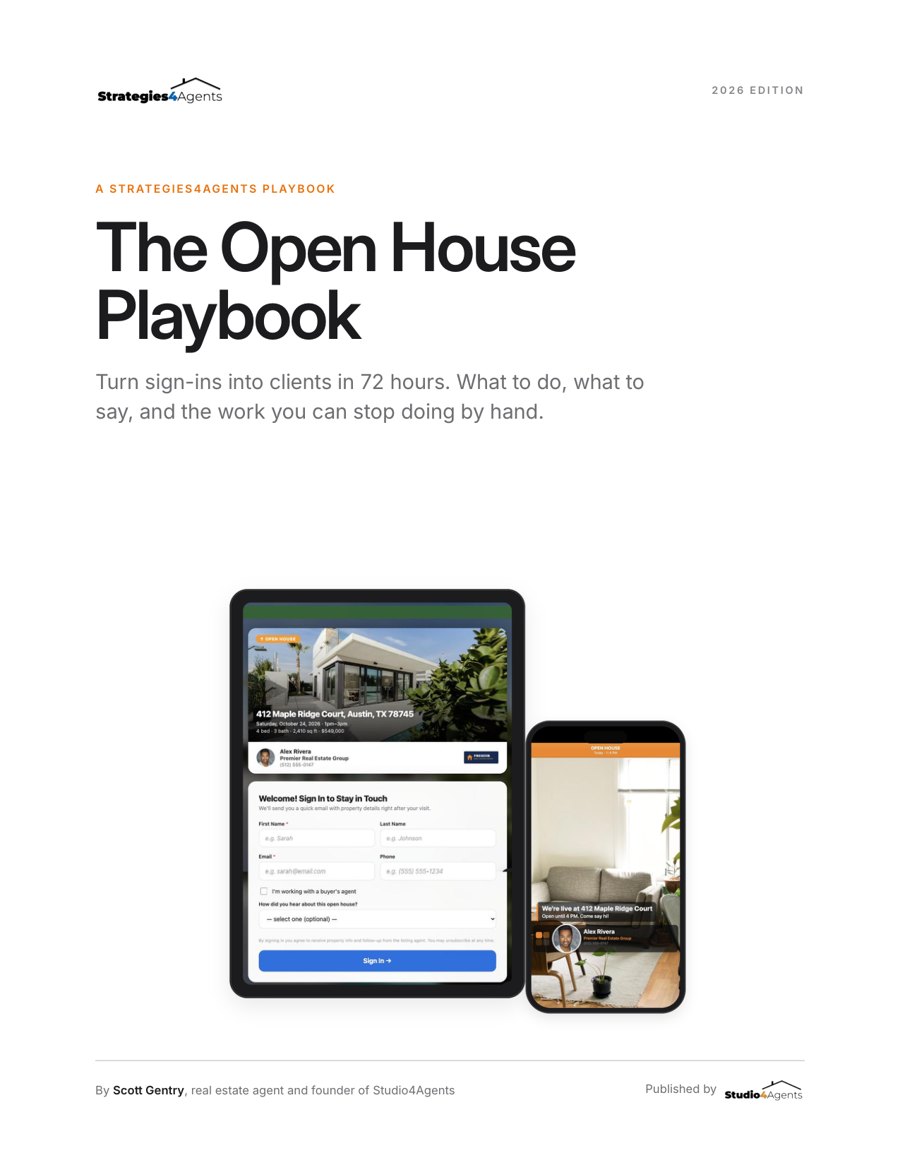
We wrote the full routine up as a free guide, The Open House Playbook, with a one-page checklist, a Read the Room card for the notes in Step 1, starting points for the tricky moments and the follow-up templates. It works with any tools.
We also built the routine into the open house tools in Studio4Agents. (Studio4Agents publishes this site, so read this as the publisher describing its own product.) Visitors sign in on a tablet at the door, and each sign-in becomes a contact right away. A thank-you goes out that day in your name, a check-in follows the next morning, similar homes from your listings go out on day 3, and a relevant article on day 10. You can rewrite any of them or stop them for one visitor. After that, each visitor's page shows what they've been reading, so you can see the signals above without guessing. The personal text in Step 2 is still yours to send. Try the open house tools in the live demo.
Start This Weekend
- Before you open. Put the sign-in where people can't miss it, and tell visitors what they'll get: details on this home and similar ones, nothing more.
- Before you leave. Ten minutes in the car. One line per conversation.
- That evening. A personal text to everyone you really talked with, using their line.
- Monday morning. Sort the list into four groups and send each group its one next step.
- The next two weeks. Two or three useful touches, a call for anyone who shows a strong signal, then a lighter rhythm for the rest.
"Every visitor walked in for a reason. Follow up on the reason, not the sign-in."
The Bottom Line
Open houses don't fail on Sunday. They fail on Monday, when the sign-in sheet becomes a chore and the follow-up becomes a group email. The agents who turn open houses into clients aren't better hosts. They write down what people said, reply while the visit is still fresh, send each person one useful thing and keep showing up for two weeks.
It's not complicated. It just has to happen before Thursday.